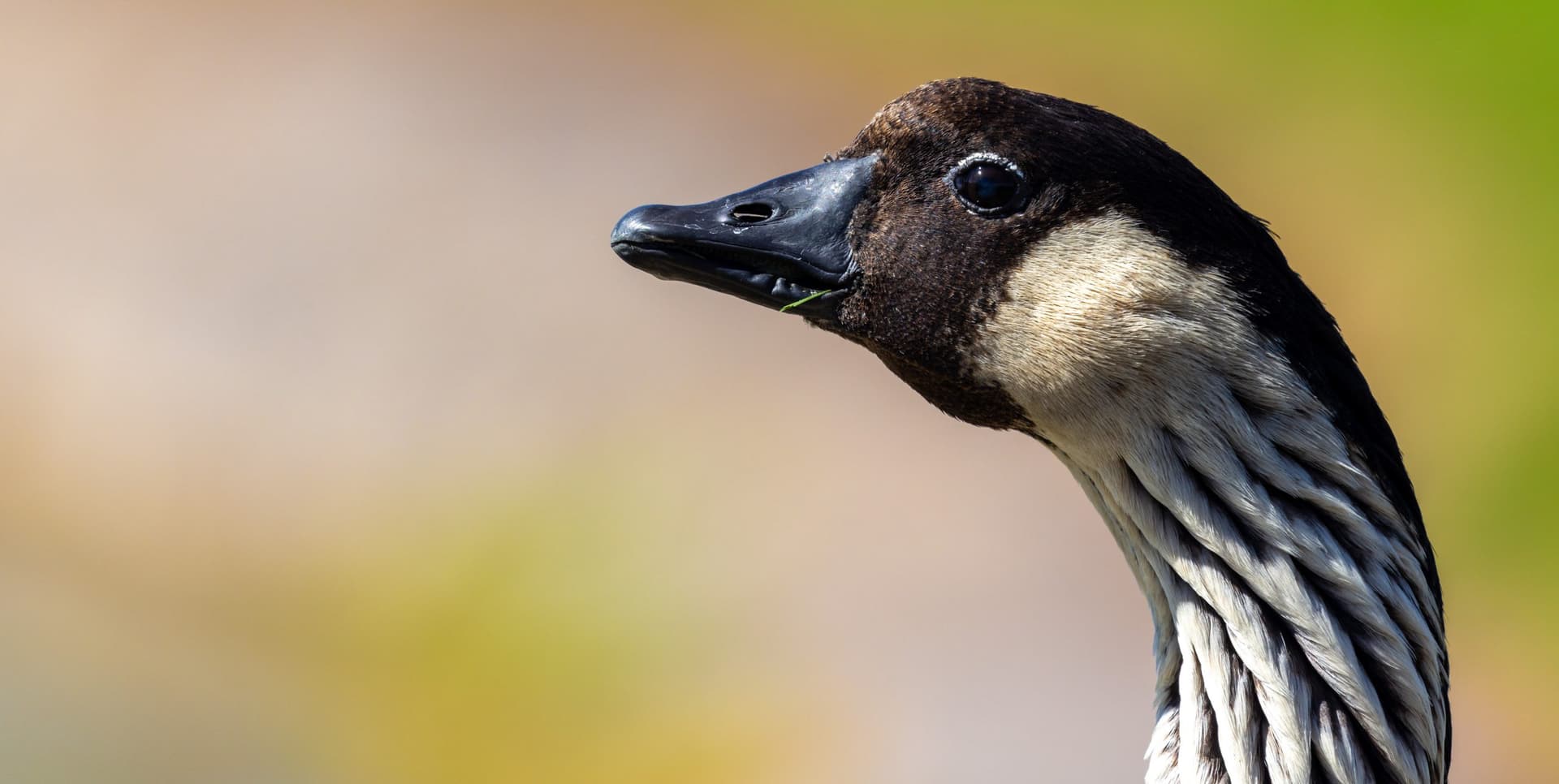
Conservation timeline
From the 1949 low point to the 2024 5-Year Review.
From 30 wild birds to the current statewide count
By 1949, nēnē were down to about 30 wild birds, all of them on Hawaiʻi Island (Smith 1952). Captive breeding at Pōhakuloa, an ex situ flock at the Wildfowl Trust in Slimbridge, predator control that didn't let up, and reintroductions on multiple islands pulled the wild population back up to roughly 4,323 birds across five islands by 2025 (NRAG count), the highest statewide count on record. Recovery happened. It just wasn't even across islands, and the species still depends on active management.
Historical context
Subfossil evidence shows nēnē once lived on every major Hawaiian Island, from sea level up to the subalpine. Genetic diversity collapsed in the prehistoric period (roughly 900 to 350 years before present), and Kauaʻi was extirpated then (Paxinos et al. 2002). Hunting, habitat conversion, and introduced predators (including the small Indian mongoose released on Hawaiʻi Island in 1883) pushed the decline through the 1800s. A 1907 territorial hunting ban came too late to stop it. By 1949 only about 30 wild birds were left, all on Hawaiʻi Island (Smith 1952). The often-cited "25,000 pre-contact" figure comes from Baldwin's own 1945 paper, where he admits he made the number up for convenience. No rigorous pre-1944 estimate exists.
Conservation efforts
Herbert Shipman, a Hawaiʻi Island rancher, kept a small private captive flock from the 1910s on. His birds became the founding stock for the State of Hawaiʻi captive breeding facility at Pōhakuloa, set up in 1949 under J. Donald Smith and the Hawaiʻi Board of Agriculture and Forestry. In 1950, three nēnē were sent to Sir Peter Scott at the Wildfowl Trust at Slimbridge, England, to build a parallel ex situ population. The first captive-bred releases back into the wild happened on Hawaiʻi Island in 1960, with Maui releases starting in 1962. Captive propagation ran for more than six decades. USFWS ended the program in 2011 once the wild population was judged self-sustaining.
Population milestones
Nēnē was federally listed as endangered in 1967, with about 279 birds. The first federal recovery plan was approved in 1983 (population 400 to 450). A revised draft plan came out in 2004 (1,304 birds) but was never finalized. The 2011 5-year review counted 1,888 to 1,978. In December 2019, USFWS published the final rule reclassifying nēnē from endangered to threatened (effective January 21, 2020), citing a 2017 statewide count of 3,252. The 2024 5-Year Review reported 3,861 birds for 2022; the most recent NRAG estimate is 4,323 birds for 2025, the highest statewide count on record, with Kauaʻi continuing to lead the gains.
Recovery planning and downlisting
2004 Draft Revised Recovery Plan
USFWS issued a Draft Revised Recovery Plan in 2004. It was never finalized, but it has shaped agency and partner work ever since. Its downlisting criteria, which had to be met and then held for 15 years, were:
Self-sustaining populations
- At least 7 populations established: 2 of 500 breeding adults each, 1 of 300, 2 of 250, and 2 of 100.
- The three largest populations have to be on Hawaiʻi, East Maui, and Kauaʻi. Two of the smaller ones have to be on East Maui, Molokaʻi, Kahoʻolawe, or Lānaʻi.
- Populations have to be stable or growing without further captive-bred releases. Habitat management can continue.
Habitat protection and management
- Enough suitable habitat to support nēnē at the required population levels has to be identified, protected, and managed in perpetuity.
- The habitat that matters most: nesting and rearing areas, summer flocking grounds, and migration routes, especially on Hawaiʻi.
2019 final downlisting rule
USFWS proposed downlisting in 2018 (83 FR 13919) and finalized it on December 19, 2019 (84 FR 69918). The rule took effect January 21, 2020. The decision rested on a five-factor analysis under ESA § 4(a)(1), not on the 2004 plan's specific population criteria. The agency concluded that nēnē was no longer in danger of extinction throughout its range but was still likely to become so in the foreseeable future. That's the statutory definition of threatened.
What the population looked like
- The 2017 statewide count was 3,252 birds: Kauaʻi (1,482), Hawaiʻi Island (1,104), Maui (627), Molokaʻi (37), and Oʻahu (2).
- Captive propagation had ended in 2011. The Hawaiʻi, Maui, and Kauaʻi populations were considered self-sustaining without further releases.
- USFWS paired the downlisting with a species-specific Section 4(d) rule (50 CFR 17.41(d)) that carves out certain non-lethal hazing, predator control, and habitat management activities from federal take prohibitions.
What the 2024 5-Year Review found
- 2025 NRAG statewide count: 4,323 birds, the highest on record, up from the previous peak of about 3,865 in 2020. (There was no 2024 estimate.)
- Toxoplasmosis from feral and free-roaming cats got bumped up to a named threat, with the highest seroprevalence on Molokaʻi.
- USFWS recommended a Species Status Assessment, a finalized new recovery plan, and a reassessment of delisting criteria. The agency is on record that this needs to happen.
A harder look at the numbers
- Kauaʻi went from 1,482 birds in 2017 to 2,435 in 2022, roughly 63 percent of the statewide total. No mongoose is the main reason.
- Hawaiʻi Island went from 1,104 to 1,082 over the same window. Maui dropped from 627 to 338. That's nearly half, and the 2024 5-Year Review doesn't yet explain it.
- Molokaʻi fell from 37 birds (2017) to 6 by 2021–2023 before recovering to about 30 by 2025. The small population stays highly vulnerable, and reintroduction support continues.
- The 2004 plan's specific recovery criteria were not technically met at downlisting. Without the 2011 to 2016 translocation of 646 birds off Kauaʻi (598 to Hawaiʻi Island, 48 to Maui), Hawaiʻi Island would have held about 493 birds, under the plan's 500-bird threshold.
What delisting would require
- Under the 2004 plan, populations would need to stay stable or growing for another 15 years past downlisting (30 years in total). Counting from the 2020 effective date, that puts the earliest delisting date around 2034.
- Habitat would have to be identified, protected, and managed in perpetuity on every major island that holds nēnē.
- A 5-year post-delisting monitoring plan would have to be in place, to confirm the species can hold without ESA protections.
- Current trends on Maui and Molokaʻi make a 2034 delisting target unrealistic without major change on those islands.
- So much of the statewide total sits on Kauaʻi that a single biosecurity failure (mongoose getting established, especially) could undo recovery fast. The 2024 5-Year Review specifically calls for a Kauaʻi mongoose prevention and interdiction program.
Nēnē Conservation Timeline
Nēnē were down to about 30 wild birds in 1949, all on Hawaiʻi Island. Here is what happened between then and the 4,323 counted in 2025.
First Western Documentation
Nēnē population first recorded during Captain Cook's arrival in Hawaiʻi, with an estimated 25,000 individuals.
Shipman Family Begins Breeding Efforts
Herbert Shipman starts breeding nene at his family’s estate in Hāʻena, recognizing the species’ decline and laying early groundwork for conservation.
Population Crisis
Dramatic population decline due to habitat loss, over-harvesting, and introduced predators like mongooses and feral cats, reducing the population to fewer than 30 birds by 1949.
Shipman Relocates Nene After Tsunami
After a devastating tsunami wipes out half of his flock, Herbert Shipman moves part of the remaining nene to the family’s ʻĀinahou Ranch in Volcano for safety.
Conservation Begins
Nēnē Restoration Project initiated by the State of Hawaiʻi and U.S. Fish and Wildlife Service, starting captive breeding at Pōhakuloa as the global population drops below 30 birds.
International Breeding Program with Shipman Contribution
Captive breeding efforts begin at the Severn Wildfowl Trust in Slimbridge, England, bolstered by breeding pairs sent by Herbert Shipman; a wild female is added in 1950–1951 to enhance genetic diversity.
First Experimental Release
30 captive-bred Nēnē released on Hawaiʻi Island in the first, small experimental release. Sustained reintroduction began with the 1960 releases.
Local Breeding Facility and State Bird Designation
Establishment of a propagation facility at Pōhakuloa and designation of the Nēnē as Hawaiʻi's state bird, boosting public awareness.
Maui Reintroduction
Thirty nēnē from Slimbridge and five from Pōhakuloa were released at Palikū in Haleakalā Crater on July 26, 1962, the first captive-bred birds freed on Maui.
Endangered Listing
Nēnē listed as Endangered under the Endangered Species Preservation Act, with a population of 279 individuals (240 on Hawaiʻi, 39 on Maui).
Predator-Resistant Enclosures
Construction of predator-resistant fenced enclosures in Hawaiʻi Volcanoes National Park to protect Nēnē populations.
Predator Identification
Mongooses and feral cats identified as major predators; roadkill becomes a significant concern with increasing vehicle traffic.
Kauaʻi Reintroduction
Releases at Kōpū Kai on Kauaʻi begin with 18 birds, growing to 620 by 2003 as populations disperse across the island.
Propagation Expansion
Keauhou Bird Conservation Center begins operations for propagation across multiple islands.
Formation of NRAG
Nēnē Recovery Action Group (NRAG) forms to coordinate conservation efforts among agencies.
Statewide Database and HEBCP Formalization
Development of a statewide Nēnē database and formalization of the Hawaiian Endangered Bird Conservation Program (HEBCP).
Enhanced Collaboration
NRAG enhances collaboration, with backcountry propagation occurring at Pālīku, Haleakalā National Park.
Safe Harbor Agreements
Finalization of Safe Harbor Agreements with ranches on Molokaʻi and Hawaiʻi, supporting habitat management and releases.
Habitat Expansion
Kauaʻi populations rise to 1,304 individuals across four islands as sugar industry closures create new pastureland habitats.
Breeding Program Success
HEBCP propagation program ends after releasing over 400 Nēnē, with a population of 1,888–1,978 individuals.
Innovation in Protection
"Rescue" pens introduced to improve gosling survival rates in the wild.
Downlisting to Threatened
Nēnē downlisted from Endangered to Threatened under the Endangered Species Act, with a population of 3,252 individuals.
Population Growth
Population reaches 3,861 individuals, with significant growth on Kauaʻi (2,435 birds).
Efforts to Reduce Vehicle Collisions
Implementation of speed limit adjustments and speed tables on Hawaiʻi Island to reduce Nēnē roadkill.
Continued Conservation
Ongoing predator control, habitat management, and community monitoring efforts to sustain recovery. No statewide NRAG estimate was produced this year.
Highest Statewide Count on Record
NRAG statewide estimate reaches about 4,323 nēnē, a new high, led by continued growth on Kauaʻi (2,643 birds).
Where things stand, and what still needs work
Nēnē are still a conservation-reliant species. The 2024 5-Year Review flags a stack of threats. None of them are new. They've just shifted in priority since the 2019 downlisting.
Active threats
- Predation by mongoose, feral cats, dogs, rats, and pigs. Kauaʻi nest success runs 75 to 82 percent on managed lands. On Maui and Hawaiʻi Island, it's 57 to 62 percent.
- Toxoplasmosis from cats. The most common infectious disease in nēnē, with the highest seroprevalence on Molokaʻi.
- Vehicle collisions, with a documented November to December peak on Hawaiʻi Island.
- Wind energy take on Maui. The 2024 5-Year Review notes that mitigation has not kept up with cumulative take under existing HCPs.
- Mongoose biosecurity on Kauaʻi. Roughly 350 sightings since 1968 and four confirmed captures since 2012 at port and airport sites. No established breeding population yet. If that changes, the consequences would be severe.
What the 2024 5-Year Review asks for
- A Species Status Assessment, and a finalized recovery plan with reassessed delisting criteria.
- A Kauaʻi mongoose prevention and interdiction program. Built before establishment, not after.
- Deal with cat colonies near nēnē habitat. Toxoplasmosis risk, plus habituation that draws birds into unsafe locations.
- Investigate the Maui decline (627 in 2017 to 338 in 2022) and figure out whether a genetics management plan is needed.
Public sightings, especially of banded birds, goslings, and birds in unusual places, feed straight into the monitoring datasets that DOFAW, USFWS, and the Nēnē Recovery Action Group use to track these trends.
Data sources
Population counts and recovery context on this page draw on the USFWS 2024 5-Year Review, the 2019 Final Downlisting Rule (84 FR 69918), the 2004 Draft Revised Recovery Plan, Smith (1952), and Nēnē Recovery Action Group annual counts. A few selected references:
- Nene.org Data Timeline
- USFWS 2024 5-Year Review (PDF)
- USFWS Draft Revised Recovery Plan (2004)
- Nene Research & Conservation Updates
- Wikipedia: Nene (bird)
- W.H. Shipman, Limited History
More context comes from peer-reviewed work in the Conservation Resources library, agency documents from USFWS Pacific Islands and the Hawaiʻi Department of Land and Natural Resources, and the Nēnē Recovery Action Group (NRAG).